
Prompt library · Embroidery
Embroidery design prompts
An embroidery prompt becomes a stitch file, so write it the way you would brief a digitiser: what the motif is and how it should feel, the size in millimetres, where it sits on the garment, the thread colours, and the cloth it is sewn on.
Example brief
I need a left-chest logo for a corporate polo, 80 mm wide. The initials “RK” in a bold, slightly condensed serif, centred inside a thin circle about 1.5 mm thick, with even breathing room between the letters and the ring. One colour only, navy thread. The polo is 220 GSM cotton pique, so the letters should be solid enough to sit on top of the knit texture without the pique showing through.
What an embroidery prompt must say
Four things the file needs. Write them the way you would brief your own team — leave one out and the engine asks before it draws.
01
Size in millimetres
Small lettering under 5 mm is sewn differently, so the size changes the stitches.
02
Where it sits
Left chest, cap front, neckline, cuff, yoke — the placement sets the hoop and the shape.
03
Thread colours
Name the colours or the count. Every colour is a stop on the machine.
04
The cloth
Pique, denim, silk, towelling — density, underlay and pull compensation follow the cloth.
Weak prompt
A nice logo for my shop.
Leaves the engine to guess the size, colours, layout and cloth.
Strong prompt
A left-chest logo for our staff polos, 80 mm wide and about 45 mm tall. The word “Kavya” in a flowing script, with a small lotus of five petals sitting just above the K. Navy thread for the lettering and a warm gold for the lotus, so two colours in all. It is sewn on 220 GSM cotton pique, so keep the script open enough that the thin joins do not sink into the knit.
Names everything the file needs, so it is right first time.
54 embroidery prompts, ready to copy
Each one is a full brief. Copy it, change the details to your own, and paste it into PatternAI.
Logos and badges
10 prompts
Corporate, school and club marks sized for the garment they go on.
01
I need a left-chest logo for a corporate polo, 80 mm wide. The initials “RK” in a bold, slightly condensed serif, centred inside a thin circle about 1.5 mm thick, with even breathing room between the letters and the ring. One colour only, navy thread. The polo is 220 GSM cotton pique, so the letters should be solid enough to sit on top of the knit texture without the pique showing through.
02
A round school badge, 75 mm across, for blazers and shirt pockets. Inside a navy shield: an open book at the bottom, a small oil lamp with a flame rising from its pages, and a ribbon across the top for the motto. Use gold for the book and lamp, white for the ribbon and the flame highlight, navy for the shield. It goes on polyester-viscose twill, so keep the fills even and the ribbon lettering readable at this size.
03
Logo for the aprons of a tea café called “Chai Adda”, about 90 mm wide. A simple steaming cup in a warm brown outline with three curling lines of steam, and the name below in a friendly rounded lettering. Brown for the cup and text, cream for the steam and a small saucer highlight. The aprons are heavy cotton canvas that will be washed often, so make it sturdy rather than delicate.
04
A hotel crest for white bathrobes, 70 mm tall. A small crown sitting over two crossed keys, the key bows decorated with a simple loop, and a thin laurel curving around the lower half. Gold thread only, one colour. It is sewn on thick terry towelling, so it needs a firm underlay and a topping so the loops of the terry do not poke through the fills.
05
Gym logo for the front of a cap, 55 mm tall and about 70 mm wide. A dumbbell set horizontally inside a hexagon outline, with the gym name “IRON HOUSE” in tight block capitals underneath the hexagon. White thread on a black structured cap of cotton twill. Keep the hexagon outline bold enough to read from across a room and shape it so it sits well on the curve of the cap front.
06
A round patch, 60 mm across, for a trekking group’s jackets. A mountain peak with a snow cap, a rising sun half behind it, and two small pine trees at the base. Four colours: sky blue background, white snow, orange sun and dark green trees. Finish it with a merrowed edge in dark green on twill backing so it can be sewn or ironed onto the jackets later.
07
Just the company name “Shree Textiles” on the pocket of a white formal shirt, 100 mm wide. Clean block capitals with slightly generous letter spacing, no logo, one colour in black thread. The shirt is fine cotton poplin, so keep the satin columns narrow and the stitch count light so the pocket does not pucker or stiffen.
08
A badge for security staff uniforms, an 80 mm shield. A five-pointed star in the centre, the word “GUARD” on a band across the lower part of the shield, and a thin double border around the edge. Navy for the shield, white for the band and border, yellow for the star. The uniform is polyester gabardine, so it can take a dense fill without trouble.
09
College sports badge for the team’s fleece jackets, 70 mm tall. A running cheetah in side view, mid-stride, inside an open laurel wreath that curves up both sides. Maroon for the laurel, gold for the cheetah with a few maroon spot details. Fleece is thick and lofty, so use a solid underlay and a topping so the cheetah’s legs and tail stay crisp instead of sinking into the pile.
10
A small brand tag for the back pocket of our jeans, 40 mm wide. A stitched arc running across the top of the pocket and a single letter “M” in a bold slab serif below it. Tan thread on 12 oz indigo denim, the classic jeans look. Keep it simple and strong; denim is heavy, so it can take a firm satin without puckering.
Necklines, yokes and borders for ethnic wear
10 prompts
Kurta, kurti and blouse work laid along the curve of the garment.
11
A kurta neckline border for a round neck with a short front placket. A continuous rose-and-leaf vine about 25 mm deep follows the curve of the neckline and runs down both sides of the placket, with small open roses every 40 mm and pairs of leaves between them. Two colours: maroon for the roses and gold for the leaves and stem. It is sewn on viscose rayon, so keep the density moderate to avoid puckering on the curve.
12
Neckline embroidery for a silk kurta with a deep round neck. A fine chain of small gold beads in satin stitch traces the neckline, and at centre front two peacocks face each other with their tails sweeping down, a lotus between them. Three thread colours: gold, peacock blue and a deep green. The whole placement is about 180 mm wide and 120 mm deep, sewn on art silk.
13
Back neck for a saree blouse with a deep U, 220 mm wide at the shoulders. A trail of small mango butis about 20 mm tall runs along the U, with tiny dots spaced between them and a thin outline following the edge of the neck. Gold and red thread on raw silk. The design should feel rich but not heavy, with the densest work at the bottom of the U and lighter work towards the shoulders.
14
A square yoke for a cotton kurti, 180 mm across. Fill the square with a small mughal-style jaal: a lattice of tiny four-petal flowers linked by curved stems, each cell about 25 mm. White thread on white cotton cambric, tone on tone, so the texture does the work. Keep the stitches light and flat so the yoke stays soft against the skin and washes well.
15
A sleeve border for a rayon kurta, 40 mm deep, running all the way around a 300 mm cuff without a visible join. A running leaf creeper with small pink buds every 30 mm and a thin straight line above and below to frame it. Green for the leaves and the framing lines, pink for the buds. The repeat must close neatly where the border meets itself at the underarm seam.
16
A tall floral spray for the front panel of a kurta, in the style of white shadow-work embroidery. Around 250 mm tall, starting from a cluster of leaves at the hem and rising into three small flowers with fine stems and buds. White thread on pastel blue cotton. Keep the stitches fine and delicate, with light satin petals and running-stitch stems, so it looks hand-done rather than machine-heavy.
17
Yoke for an anarkali with a round neck, sewn on georgette. A ring of small paisleys, each about 30 mm long, sits around the neckline with their tips all pointing clockwise, and tiny three-dot clusters fill the gaps between them. Copper and gold thread. Georgette is light and sheer, so keep the density low, use a soluble backing and avoid long jumps that will show through.
18
A men’s kurta placket, 300 mm long and 35 mm wide. A thin geometric border of interlocking diamonds running down both sides of the button stand, with a small square motif at the top where the placket meets the neck. Cream thread on beige linen, very understated and festive enough for a wedding guest. Linen frays and puckers easily, so keep the satin narrow and the underlay simple.
19
A corner motif for a chanderi dupatta, about 150 mm. A single lotus in full bloom with two leaves curling out from under it and a short stem, placed so it sits neatly in the corner at a 45-degree angle. Soft pink for the petals and two greens for the leaves. The fabric is sheer, so the stitches must be light and the back must be clean, since the dupatta will be seen from both sides.
20
A scatter of small butis for the sleeves of a saree blouse. Each buti is a tiny flower about 25 mm tall, spaced 60 mm apart in a staggered grid, so the sleeve looks evenly dotted rather than in straight rows. Gold thread on dark green silk. Keep each buti compact and well tied off so the jumps between them can be trimmed cleanly.
Monograms and lettering
8 prompts
Names and initials sized so small text still holds.
21
A monogram “A S” for the cuff of a white formal shirt, 50 mm wide. The two letters in an elegant interlocking script, the A slightly taller than the S, with the swashes of the S wrapping around the crossbar of the A. Gold thread on white cotton poplin. Keep the satin columns fine so it looks refined rather than bulky on the cuff.
22
A baby name “Aarav” for a cotton bib, 60 mm wide. Soft, rounded lowercase letters with a small five-pointed star dotting the end of the name. Sky blue thread on white cotton. The bib will be washed again and again, so make the letters sturdy, with no tiny gaps that could catch on fingers.
23
Towel monogram, a single letter “P” in a classic serif, 90 mm tall, for a set of bath towels. Navy thread on white terry towelling. The pile is deep, so use a strong underlay and a water-soluble topping, so the letter sits crisply on top of the loops and the serifs do not disappear.
24
A wedding keepsake for a satin cushion cover. Two small hearts linked together at the top, and below them the date “12.12.2026” in a light, elegant numeral style, 70 mm wide in all. Red for the hearts and gold for the date. Satin is slippery and shows every pull, so keep the density light and hoop it firmly.
25
Team name across the back of a jacket, “ROYALS”, 250 mm wide, arched upward in the centre like a classic sports jacket. White fill letters with a black outline about 2 mm wide. It goes on polyester satin jacket fabric, so it needs good underlay and pull compensation to keep the letters from narrowing as they sew.
26
A name on a doctor’s lab coat, “Dr. Meera Rao”, 70 mm wide. Clean block letters, all on one line, set just above the left chest pocket. Navy thread on white poly-cotton. Keep it simple and professional: no logo, no flourish, letters about 7 mm tall so they are easy to read from across a consulting room.
27
Hindi lettering “शुभ विवाह” for a wedding gift on red velvet, 120 mm wide. The matras and the top line must stay clear and joined exactly as the script is written, with a small floral flourish at both ends of the text. Gold thread. Velvet has a deep pile, so use a topping so the thin parts of the letters do not sink in.
28
Initials “J&K” inside a thin oval, 30 mm tall, for the corner of white linen handkerchiefs. A classic serif with the ampersand slightly smaller than the letters. White thread on white linen, tone on tone. It is very small, so the letters must be kept simple enough to stay readable at this size.
Florals and motifs
8 prompts
Stand-alone designs for panels, pockets and accessories.
29
A spray of three roses with buds and leaves for the back of a denim jacket, 120 mm tall. One rose fully open in the centre, two half-open on either side, with two small buds and five leaves trailing from the stems. Three colours: pink and red for the roses with shading between them, and a fresh green for the leaves. Denim is strong, so this can carry full, rich fills.
30
A small daisy cluster for the pocket of a kids’ T-shirt, about 45 mm. Three daisies of slightly different sizes overlapping, with white petals and yellow centres, and a single green leaf. The tee is single jersey, which stretches, so use a cut-away backing and keep the stitches soft enough not to scratch a child’s skin.
31
A paisley with a curled tip and an inner floral fill, 100 mm tall. The outer shape is outlined in a bold satin, and inside it there is a small flower, a leaf and a few dots arranged along the curve. Three colours: teal outline, mustard flower and maroon details. Sewn on medium-weight cotton for a cushion or a bag panel.
32
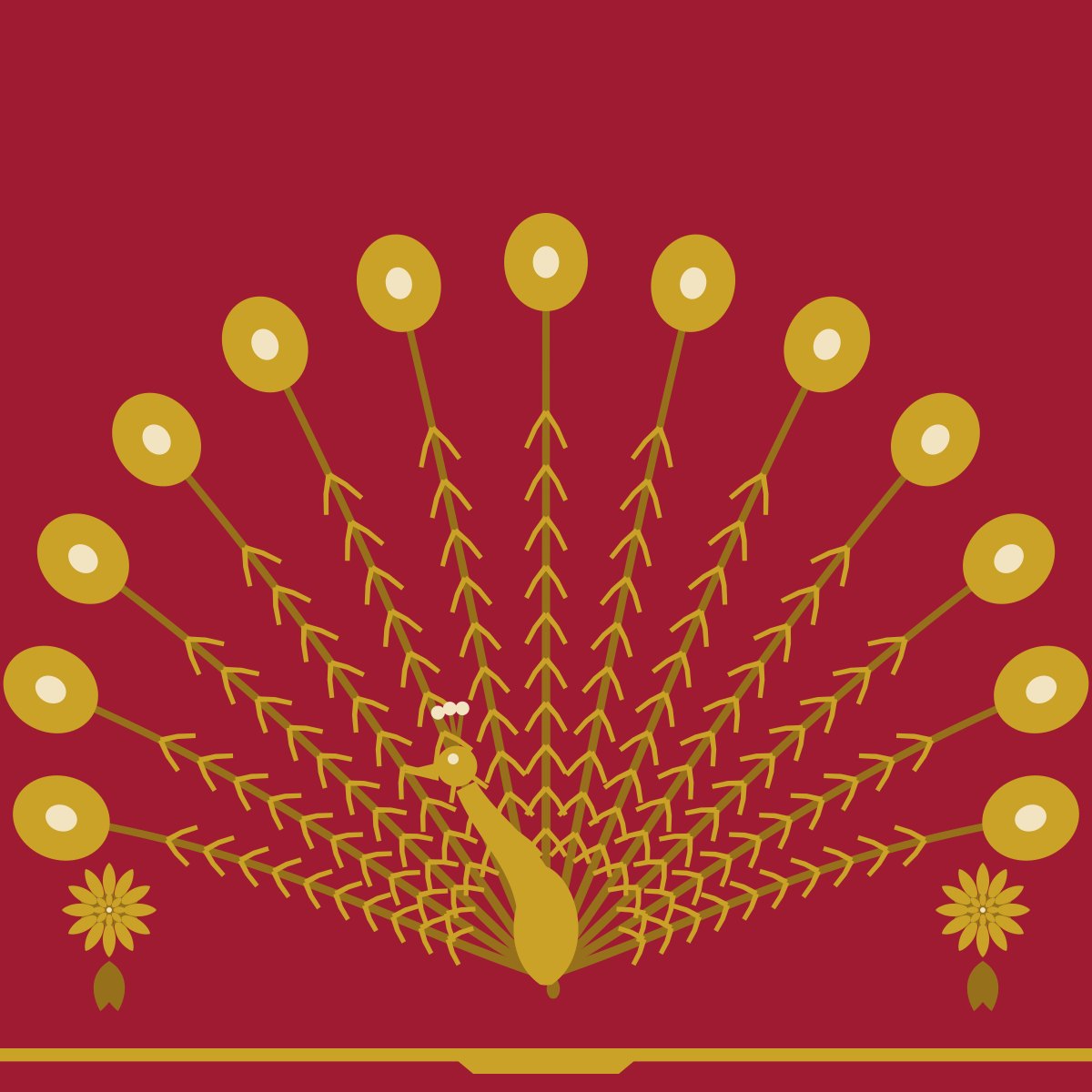
A peacock with a spread tail for the front of a silk cushion, 200 mm tall. The body is in profile on the left, and the tail fans out to the right as a half circle of feathers, each feather ending in an eye. Blue, green and gold thread. It is a showpiece, so allow rich shading in the tail, but keep the density right for silk so it does not pucker.
33
An elephant with a decorated saddle cloth for a canvas tote bag, 90 mm. The elephant faces left, trunk slightly raised, with a patterned saddle cloth and small bells along its edge. Red for the cloth, orange for the trim and gold for the bells, with a grey outline for the elephant. Canvas is sturdy, so the fills can be solid.
34
A hummingbird feeding at a hibiscus flower for the corner of a linen napkin, 110 mm. The bird hovers with wings up, beak reaching into the flower. Five colours: emerald and teal for the bird, coral and deep red for the hibiscus, and green for one leaf. Linen is fine and shows puckering, so keep it light and clean on the back.
35
A line-art lotus, 80 mm wide, worked as a single continuous running stitch outline with no fills at all. White thread on black cotton. The look is minimal and modern, like a pen drawing, with the petals overlapping and a couple of water lines below.
36
A pair of tropical leaves for the front of a rayon resort shirt, 140 mm tall. One monstera leaf and one palm frond crossing at the stem, with fine vein lines inside each. Two greens, a deep forest and a lighter leaf green. Rayon is light and drapey, so keep the stitch count modest so the shirt still falls naturally.
Caps, jackets and sportswear
6 prompts
Placements on curved and stretch garments.
37
A cap front with bold raised-look letters, 50 mm tall, three letters “NYK” in a strong athletic block font. White thread on black cotton twill, a structured six-panel cap. Make the letters wide and solid so they read clearly from a distance, and shape them to sit centred on the curve of the front panels.
38
A small flag for the side of a cap, 30 mm wide. A simple three-band flag with a small emblem in the centre, three colours. It sits on the side panel of a structured cap, just above the strap, so keep it compact and slightly angled to follow the panel.
39
A chest logo for a track jacket, 70 mm wide. A clean swoosh-like curve sweeping up from left to right, and the word “AURA” in a sporty italic just below it. White thread on navy polyester tricot. Tricot is slippery and stretches, so it needs a cut-away backing and good pull compensation.
40
College arc lettering across the front of a hoodie, “STATE”, 260 mm wide. Classic varsity block letters arched in a gentle curve across the chest. Cream thread on a heather grey cotton fleece. The fleece is thick, so give the letters a solid underlay and a topping so they stand clean on the surface.
41
A cricket club badge for a team jersey, 65 mm tall. Two crossed bats with a red ball in front of them, inside a simple navy shield. Navy, white and red thread. The jersey is a stretch polyester knit that moves a lot, so the badge must be light enough to flex with the fabric and not pull it out of shape.
42
A sleeve number “23” for a varsity jacket, 120 mm tall. Bold athletic numerals in gold with a 3 mm white outline. It goes on the sleeve of a wool felt jacket, so the numbers can be dense and rich, but keep the outline evenly spaced all the way round.
Home and gifting
8 prompts
Towels, cushions, table linen and gift pieces.
43
A border for a bath towel, 50 mm deep, running the full 700 mm width. A continuous rolling wave pattern, the crest of each wave curling over, with a thin straight line above it. Teal thread on white terry. Use a topping so the waves sit on top of the pile and look crisp after washing.
44
A mandala for the centre of a cushion cover, 300 mm across. Eight-fold symmetry: a small flower in the centre, then rings of petals, dots and small leaves growing outward. Five colours: indigo, teal, mustard, rust and cream. Cotton duck is sturdy, so the mandala can be full and detailed.
45
An end motif for a handloom cotton table runner, 150 mm wide. A pair of ripe mangoes hanging from a short branch with three leaves, sitting centred just above the hem. Mango yellow and orange for the fruit, two greens for the leaves. Keep it light so the runner still lies flat on the table.
46
A kitchen towel motif, 70 mm wide. A small round teapot with steam rising and the word “Chai” in a playful hand-lettered script below it. Red thread on white waffle cotton. Waffle weave has deep cells, so the letters need a good underlay to stay readable.
47
A corner for a baby blanket, 120 mm. A sleeping crescent moon with a closed eye and a little smile, surrounded by four small stars of different sizes. Pastel yellow for the moon and stars, soft blue for the face details. It is sewn on soft fleece, so use a topping and make sure nothing is scratchy for the baby.
48
A napkin set with a single olive sprig in one corner, 50 mm. A thin stem with five small leaves and two olives. Two greens, a dark olive and a lighter sage. Linen napkins, so the stitches must be fine and the back neat, since a napkin is seen from both sides.
49
A Christmas stocking cuff with the name “Mia”, 100 mm wide, and a small snowflake to the right of the name. White lettering on a red felt cuff, with the snowflake in white too. Felt is thick and stable, so the letters can be bold and solid.
50
A corner motif for a pooja cloth, 80 mm. A small kalash with a coconut on top and five mango leaves fanning out around it. Gold thread for the kalash and green for the leaves. It is sewn on silk, so keep it light and neat.
Full studio briefs
4 prompts
Longer briefs, the way a design studio hands work to the digitiser.
51
Bridal kurta front for a winter wedding, sewn on ivory raw silk. A tall panel 320 mm high and 160 mm wide running down the centre front from the neckline: a tree-of-life with a slim trunk, curling branches and small birds perched at three levels, with tiny buds and leaves filling the gaps. Gold for the trunk and branches, antique copper for the birds, and a muted rose for the buds. The densest work sits near the neckline and thins out toward the hem, so the panel feels light at the bottom. Keep satin columns under 7 mm so the silk does not pucker.
52
Corporate gift set for a jewellery brand: a 60 mm logo for the front of a velvet pouch and a 30 mm version of the same logo for a matching cotton handkerchief. The logo is a thin diamond outline with the brand initial “T” in a high-contrast serif inside it. Gold thread on midnight blue velvet for the pouch, and white on white for the handkerchief. The small version must be redrawn with simpler serifs rather than just shrunk, so it stays clean at 30 mm.
53
A kids’ school-bag panel, 180 mm wide and 140 mm tall, on heavy polyester canvas. A cheerful rocket blasting off from the bottom left toward the top right, with three round windows, a flame trail made of orange and yellow tongues, and four small stars around it. Five colours: red rocket, white windows, orange and yellow flames, and navy stars. Make the outlines bold and the fills solid, since the bag will be thrown around and scrubbed.
54
Back of a festive Nehru jacket, wool blend, a 200 mm medallion centred between the shoulder blades. An eight-pointed star with a small rosette at its heart, each point filled with a tiny paisley, and a ring of dots around the whole medallion. Tone on tone in a slightly darker shade of the jacket’s bottle green, with gold only for the ring of dots. The look should be subtle from a distance and rich up close.
Prompts for the other engines
Every engine has its own recipe — what its machine file needs to know.
Make your embroidery design
Try PatternAI on your own designs free for 7 days. After that you pay only for what you produce.
Paste a prompt
Copy any prompt above, change the details to yours, and get the design and the machine file.
Start free