
Prompt library · Quilt
Quilt design prompts
A quilting prompt becomes one continuous path, so write it the way a quilter describes a design to a friend at the machine: the layout — edge-to-edge, block, border or corner — the size, the motif and how it should flow, and the batting it has to hold.
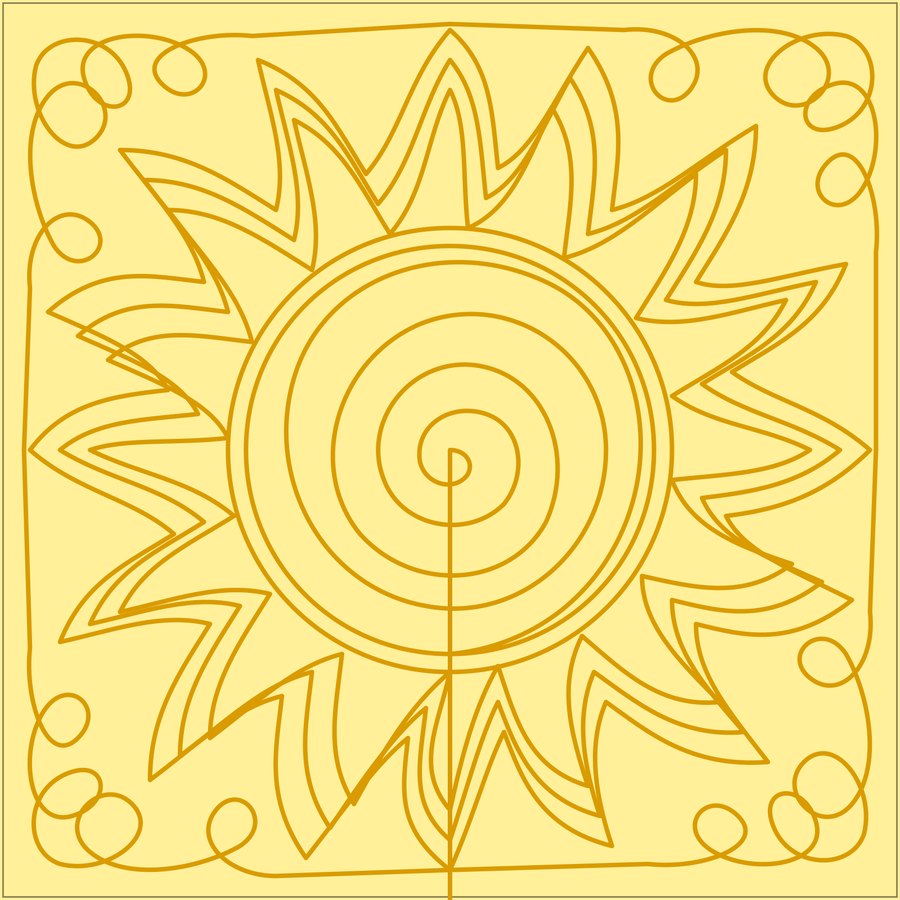
Example brief
An edge-to-edge feather meander for a queen quilt. Soft curling feathers growing off a gently wandering spine, each plume 8 to 12 cm long, rows nesting into each other so the joins never show. Medium density for cotton batting, no open space wider than about 8 cm. One continuous line per row, smooth curves throughout.
What a quilt prompt must say
Four things the file needs. Write them the way you would brief your own team — leave one out and the engine asks before it draws.
01
Layout
Edge-to-edge rows, a block, a border with corners, or a whole-cloth centre.
02
Size
Quilt size or block size in cm — rows are fitted to the machine’s width.
03
Batting
Cotton, polyester or wool — the spacing never runs further apart than it allows.
04
Motif
Feathers, meanders, stars, leaves, geometric — joined into one line.
Weak prompt
Quilt pattern.
Leaves the engine to guess the size, colours, layout and cloth.
Strong prompt
An edge-to-edge feather meander for a queen-size quilt, about 230 by 250 cm. Soft curling feathers growing off a gently wandering spine, each plume 8 to 12 cm long, the rows nesting into each other so no seam line shows. Medium density for an 80/20 cotton-poly batting, with no open space wider than about 8 cm. Smooth curves, no sharp points, one continuous line per row.
Names everything the file needs, so it is right first time.
45 quilt prompts, ready to copy
Each one is a full brief. Copy it, change the details to your own, and paste it into PatternAI.
Edge-to-edge rows
10 prompts
Rows that nest into each other across the whole quilt.
01
An edge-to-edge feather meander for a queen quilt. Soft curling feathers growing off a gently wandering spine, each plume 8 to 12 cm long, rows nesting into each other so the joins never show. Medium density for cotton batting, no open space wider than about 8 cm. One continuous line per row, smooth curves throughout.
02
An edge-to-edge design of loops and five-pointed stars for a baby quilt, about 100 by 120 cm. A loose loop-de-loop line travelling across the row, with a small star of 5 cm drawn in one stroke every so often. Light density for a lofty polyester batting, so the quilt stays soft and cuddly.
03
An edge-to-edge row of leaves on a vine for a king quilt. A curling vine runs across each row with pointed leaves of about 6 cm branching off on both sides, alternating up and down, each leaf with a single centre vein. Medium density for cotton batting. The rows lock together so the vine looks continuous across the quilt.
04
Geometric zigzag rows for a modern throw, about 130 by 160 cm. Sharp chevron lines of 6 cm high, with a parallel echo line 1 cm inside each zigzag. Medium density. The points must be crisp, with the needle stopping cleanly at each turn.
05
Edge-to-edge clamshells for a twin quilt, about 170 by 230 cm. Overlapping half circles 8 cm across, row on row like fish scales, each shell carrying one echo line 1 cm inside it. The rows nest so the tops of one row sit in the valleys of the row above. Medium density for cotton batting, smooth even curves, classic and calm.
06
An edge-to-edge design for a wedding quilt: open hearts of about 7 cm joined by small loops, with every few hearts a pair linked together at the side. The line flows without stopping across the row and the rows nest into each other. Medium density for cotton batting, romantic and soft, with no open space wider than about 8 cm.
07
An edge-to-edge paisley meander for a queen quilt: paisleys of 8 to 12 cm in different sizes, each with one echo, linked by a soft meandering line. Wool batting, so medium density is enough to show the loft. Rich and textured.
08
Edge-to-edge waves for a beach-theme throw, about 130 by 160 cm. Rolling waves about 10 cm tall, each crest curling over into a small spiral, the rows nesting into each other like the sea coming in. Medium density for cotton batting. Smooth, flowing curves with no sharp points.
09
Edge-to-edge snowflakes for a winter quilt, queen size. Six-armed snowflakes of 6 to 10 cm, each drawn in a single line with small branches on every arm, linked by soft swirls so the line never breaks. Medium density for cotton batting. The snowflakes vary in size so the quilt looks like falling snow.
10
Edge-to-edge butterflies and swirls for a kids’ quilt, about 120 by 150 cm. Simple butterflies of about 8 cm with rounded wings and curly antennae, flying among loose swirls in different directions. Light density for a lofty polyester batting, so the quilt stays soft and playful.
Blocks
8 prompts
Single blocks joined into one path.
11
A 30 cm quilt block with an eight-pointed star in the centre, about 18 cm across, and two echo lines around the star 1.5 cm apart. The background in the four corners filled with a light stipple so the star stands out in relief. One continuous path from start to end, with the points of the star sharp and clean.
12
A 25 cm quilt block with a feathered wreath around a plain 10 cm centre. Feathers grow outward on both sides of a circular spine, each plume about 3 cm, evenly spaced around the ring. The centre stays empty for a name, a date or a small appliqué. Medium density for cotton batting.
13
A 20 cm quilt block with a simple pinwheel made of straight lines: four triangles spinning around the centre, each triangle with a single echo line inside it 1 cm in. Crisp, sharp corners with the needle stopping cleanly at each turn. One continuous path, for a modern geometric quilt.
14
A 30 cm quilt block with a compass rose: eight points, the four main ones reaching almost to the edge and the four in-between ones shorter, with straight lines radiating out from the centre to the edges of the block. Strong and graphic, for a travel-theme quilt.
15
A 15 cm quilt block with a single heart centred in the block, about 9 cm wide, with one echo line 1 cm outside it. The four corners filled with a light stipple so the heart puffs up. Sweet and simple, for a baby quilt or a wedding sampler.
16
A 30 cm quilt block with a lotus flower: eight petals around a small round centre, each petal echoed twice so the flower looks layered, with a short wave line beneath it like water. One continuous path. Medium density for cotton batting.
17
A 25 cm quilt block with a single spiral that starts at the centre and winds out to the edges, the lines 1.5 cm apart. Calm and hypnotic, the spiral smooth and even. A quick, satisfying block for a modern quilt or a cushion front.
18
A 20 cm log-cabin style quilt block of nested squares, each square 1.5 cm inside the one before it, the line stepping inward from the edge to the centre without stopping. Sharp corners and straight lines. A clean, geometric block for a traditional log-cabin quilt.
Borders and corners
6 prompts
Continuous borders that turn the corner.
19
A cable border 10 cm wide for a queen quilt: two strands twisting over and under each other along the whole length of the border, each twist about 12 cm long. The cable turns the corners with neat mitres so the twist never breaks. Medium density for cotton batting.
20
A feather border 12 cm wide: feathers growing off a straight spine running along the length of the border, the plumes about 4 cm and evenly spaced. At each corner, a matching fan of feathers turns the corner so the border flows round the whole quilt without a break.
21
A scallop border 8 cm wide: a row of gentle scallops 10 cm across running along the outer edge of the quilt, with a small leaf drawn inside each curve. The scallops are spaced to fit the length of each side exactly, and turn the corners with a single wider scallop.
22
A rope border 6 cm wide, a twisting rope running continuously around a queen quilt, the twist even and regular all the way round. The rope turns the corners smoothly with a slightly tighter twist so it looks like real rope bending. Medium density.
23
A vine border 10 cm wide: a curling vine runs along the border with small leaves on both sides every 6 cm, and at each corner the vine blooms into a single open flower before turning the corner. One continuous line around the whole quilt.
24
A Greek key border 7 cm wide: the classic stepped spiral repeating along the edge of the quilt, each key about 7 cm long. Straight lines and sharp right-angled turns, turning crisply at square corners. A formal, architectural border for a whole-cloth quilt.
Themed pantographs
8 prompts
Rows with a story.
25
A pantograph of hot-air balloons and clouds for a nursery quilt. Round balloons of about 12 cm with simple panels and small baskets drift between puffy clouds, linked by a soft wandering line, the rows nesting so the sky looks full but calm. Light density for polyester batting, sweet and dreamy.
26
A pantograph of tractors and fields for a farm-theme quilt. Small tractors of about 10 cm drive along rolling furrows, with a barn and a round tree now and then. The rows nest into each other so the fields look continuous. Medium density, playful for a child’s room.
27
A pantograph of autumn leaves falling: maple, oak and birch leaves of 5 to 9 cm tumbling in a loose wind, each with a centre vein, linked by a gentle looping line. Medium density for cotton batting. The leaves face different directions so the quilt feels alive with movement.
28
A pantograph of fish and bubbles for a kids’ quilt. Round friendly fish of about 8 cm swimming in both directions, each with a big eye and a fan tail, trailing strings of small bubbles that link one fish to the next. Light density for polyester batting.
29
A pantograph of musical notes on a wavy stave: quavers, crotchets and treble clefs drawn in a single line, rising and falling along the row like a melody. The rows nest so the stave looks continuous. Medium density, for a music lover’s quilt.
30
A pantograph of dragonflies and reeds. Slender dragonflies of about 10 cm with long double wings hover above tall reeds that bend in the breeze, the line flowing from reed to dragonfly and back. Medium density for cotton batting, elegant and calm.
31
A pantograph of sun, moon and stars: a round sun with wavy rays, a crescent moon with a sleepy face and small five-pointed stars, linked by a soft swirl. Medium density for cotton batting. A gentle day-and-night theme for a child’s bed.
32
A pantograph of roses and buds for a wedding quilt. Open roses of about 8 cm with layered petals, linked by a curling vine carrying small buds and pairs of leaves. Medium density for cotton batting. The rows nest so the roses look scattered rather than in lines.
Mattress, comforter and home pieces
8 prompts
Multi-needle rows for bedding and padded goods.
33
Diamond grid quilting for a comforter: straight lines crossing at 60 degrees to form 8 cm diamonds over the whole piece, running edge to edge. Polyester batting, a clean and classic finish that holds the filling evenly so it never shifts or lumps after washing.
34
Channel quilting for a puffer-style throw: straight parallel lines 5 cm apart running the full length of the throw. Lofty polyester batting, so the channels puff up between the lines and the throw looks plump and modern. The lines must be perfectly straight and evenly spaced.
35
An onion-dome pattern for a quilted jacket lining: rows of pointed domes of about 4 cm, nesting into each other so the shapes interlock like tiles. Light polyester wadding. Smooth curves and sharp tips, a classic look for a quilted jacket or vest.
36
A small stipple for a set of quilted placemats, 45 by 30 cm each: tight wandering curves about 1 cm apart that never cross each other, covering the whole mat. Cotton batting, a flat, firm finish that lies flat on the table and washes well.
37
Wave rows for a quilted table runner, 40 by 150 cm: gentle waves about 3 cm high running along the length, the rows 4 cm apart. Light density for a thin cotton batting so the runner stays flat and drapes over the table edge.
38
A hexagon grid for a quilted cushion front, 45 cm square: hexagons of 5 cm in a honeycomb arrangement covering the whole panel, with no open gaps. Cotton batting, so the honeycomb puffs up slightly and the cushion looks textured and modern.
39
Box quilting for a baby mattress cover: straight lines forming 10 cm squares over the whole piece. Soft polyester batting, so the cover is comfortable and the filling stays in place after many washes. Lines straight and evenly spaced.
40
Kantha-style running lines for a lightweight throw: rows of short running stitches about 1 cm apart following gentle waves across the whole throw, so the cloth crinkles softly after washing. Very light batting, or none, for a flat, hand-made look.
Full studio briefs
5 prompts
Long-form briefs with exact measurements — one design, then distinct takes on it.
41
A continuous-line quatrefoil quilting design, tile 300 mm square, three columns by three rows of identical flowers at 100 mm centres. Each flower has a central circle of 26 mm surrounded by four clover petals — top, right, bottom, left — each 42 mm long and 38 mm across, with a broad rounded outer edge and a soft heart-shaped notch at its tip, tapering inward to meet the circle with a 5 mm gap. Between every four neighbouring flowers the petal outlines curve inward to meet in a delicate four-pointed star of 24 mm. Outline only, smooth curves, seamless on all four edges.
42
A dense-grid version of the quatrefoil design: five by five flowers in the same 300 mm tile at 60 mm centres, with circles of 16 mm and petals of 25 by 23 mm. The tighter grid drops the largest unquilted gap from 34 mm to about 20 mm, so the batting is held more securely. The four-pointed stars between the flowers shrink to 14 mm. Seamless on all four edges.
43
A half-drop version of the quatrefoil design: offset every other column by half a row, so the flowers sit in a brick arrangement rather than a square grid. This breaks the strong straight alleys of the square grid and changes the gaps between flowers, so redraw them where three flowers meet. Tile 300 mm square, flowers at 100 mm centres with a 50 mm offset, circles 26 mm, petals 42 mm.
44
An on-point version of the quatrefoil design: the whole grid turned 45 degrees so the flowers sit on a diagonal lattice, their petals pointing to the corners of the tile. It reads as more dynamic than a square grid, and on a longarm the diagonal path hides any small row misalignment. Tile 300 mm square, flowers at 100 mm diagonal centres, circles 26 mm, petals 42 mm.
45
A six-petal version on a honeycomb: six petals at 60 degrees around each circle, with the flowers arranged in offset rows at 100 mm centres so the six-fold flower tiles naturally and small triangular stars form where three flowers meet. Tile 300 by 260 mm to close the repeat, circles 24 mm, petals 38 mm. Denser and more organic than the square grid, with no straight alleys.
Prompts for the other engines
Every engine has its own recipe — what its machine file needs to know.
Make your quilt design
Try PatternAI on your own designs free for 7 days. After that you pay only for what you produce.
Paste a prompt
Copy any prompt above, change the details to yours, and get the design and the machine file.
Start free